Beginner's Guide to Car Polishing | Step-by-Step Tutorial

GarageA360

Member
Joined
Sep 8, 2025
Messages
33
Reaction score
10
Points
8
Location
Sri Lanka

Hi Mr. Mike,

Good day!


At the 37-minute mark in the timeline, you were talking about deep scratches. If we’re unable to remove those deep scratches or scars, what would be the next option? Would it be a complete repaint, or could we remove a thin layer of the clear coat and then apply a ceramic coating?


Thanks,
Anuruddha
 
Hi Sir,

When you do a test spot initially in order to understand about your paint correction combination, Is it necessary to do test spots for all the panels (Such as Hood, Roof, Trunk lid, side panels etc) in order to get the showroom finish?

My openion is that you can't relay on one test spot in order to understand about your whole algorithm of your vehicle paint..

Could you kindly clarify the same.


Thanks
Anuruddha
 
At the 37-minute mark in the timeline, you were talking about deep scratches. If we’re unable to remove those deep scratches or scars, what would be the next option?

Would it be a complete repaint, or could we remove a thin layer of the clear coat and then apply a ceramic coating?

The best option is to learn to live with the deeper defects that cannot be removed safely or without comprising the paint job now, or into the future.

If the car is a daily driver, then I would explain to the owner that the factory clearcoat is super thin and even if you could remove a defect like a deep scratch 100% WITHOUT buffing through the clearcoat layer of paint - you will have left the paint in that area so thin that it could lead to clearcoat failure and the only way to recover from clearcoat failure is to repaint.


Mike
 
When you do a test spot initially in order to understand about your paint correction combination, Is it necessary to do test spots for all the panels (Such as Hood, Roof, Trunk lid, side panels etc) in order to get the showroom finish?

My opinion is that you can't rely on one test spot in order to understand about your whole algorithm of your vehicle paint..

There's really only two reasons to do a Test Spot to each body panel on a car.

1: Some panels may have deeper defects.​
2: Some body panels may have been repainted and thus the paint could be harder or softer than the panel you did the initial Test Spot to.​


I don't do either. I practice and preach to do the Test Spot to a horizontal panel that you can look down on as this makes it easier and more conclusive to judge the results. Also, the horizontal panels tend to be the worst condition as compared to vertical panels. So what works on a horizontal panel should work on a vertical panel.

And of course, as you work around a car, IF you see something changing, then of course, stop with the current process and test a different process for that body panel.

To simply do a Test Spot on every body panel would require some time, maybe an hour or so and I would rather be buffing out the car and getting to the finish line than messing around doing Test Spots to each body panel when chances are VERY GOOD - the car has the same paint on each body panel so the results from testing on the hood, roof or trunk lid means you'll get the same results.

Even if a body panel has been repainted, as long as you're using quality products, matching the right pad and tool for the job, then it's quite possible the process you dialed-in on the original paint will still work on the repaint. But this is why every detailer should have good lighting so they can see if something is changing as they buff.


And of course, each person can figure out an approach that works best for them. :)


-Mike
 
Before you were applying ceremic coating, You were using another spray wast it an IPA?

That's our Paint Coating Builder. With Dr. Beasley's NSP Primers and the Nanogel carrying agent - there's no organic substances that need to be removed so you don't need a panel wipe.

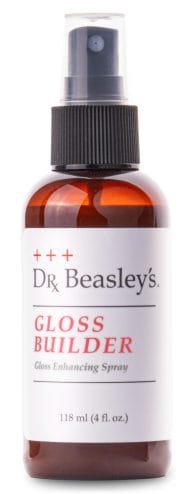
The Paint Coating Builder clarifies the paint as well as creating anchor points for the ceramic coating to bond to. Originally it was only available in 2 ounce bottles that came in our coating kits. Due to popular demand, we brough out a 4 ounce bottle called Gloss Builder. Gloss Builder can be purchased separately. I love this product, it perfectly prepares the paint for the coating and unlike a solvent like IPA or Mineral Spirits, etc., it doesn't induce marring as you wipe. Always remember, panels wipes and specifically IPA are HORRIBLE lubricants, thus on softer paints you induce marring.

Get all the information here,

Gloss Builder

full


Mike
 
The best option is to learn to live with the deeper defects that cannot be removed safely or without comprising the paint job now, or into the future.

If the car is a daily driver, then I would explain to the owner that the factory clearcoat is super thin and even if you could remove a defect like a deep scratch 100% WITHOUT buffing through the clearcoat layer of paint - you will have left the paint in that area so thin that it could lead to clearcoat failure and the only way to recover from clearcoat failure is to repaint.


Mike

I understood and Noted well Sir..
 
There's really only two reasons to do a Test Spot to each body panel on a car.

1: Some panels may have deeper defects.​
2: Some body panels may have been repainted and thus the paint could be harder or softer than the panel you did the initial Test Spot to.​


I don't do either. I practice and preach to do the Test Spot to a horizontal panel that you can look down on as this makes it easier and more conclusive to judge the results. Also, the horizontal panels tend to be the worst condition as compared to vertical panels. So what works on a horizontal panel should work on a vertical panel.

And of course, as you work around a car, IF you see something changing, then of course, stop with the current process and test a different process for that body panel.

To simply do a Test Spot on every body panel would require some time, maybe an hour or so and I would rather be buffing out the car and getting to the finish line than messing around doing Test Spots to each body panel when chances are VERY GOOD - the car has the same paint on each body panel so the results from testing on the hood, roof or trunk lid means you'll get the same results.

Even if a body panel has been repainted, as long as you're using quality products, matching the right pad and tool for the job, then it's quite possible the process you dialed-in on the original paint will still work on the repaint. But this is why every detailer should have good lighting so they can see if something is changing as they buff.


And of course, each person can figure out an approach that works best for them. :)


-Mike

Noted well Sir.. I am clear on this..
 
That's our Paint Coating Builder. With Dr. Beasley's NSP Primers and the Nanogel carrying agent - there's no organic substances that need to be removed so you don't need a panel wipe.

The Paint Coating Builder clarifies the paint as well as creating anchor points for the ceramic coating to bond to. Originally it was only available in 2 ounce bottles that came in our coating kits. Due to popular demand, we brough out a 4 ounce bottle called Gloss Builder. Gloss Builder can be purchased separately. I love this product, it perfectly prepares the paint for the coating and unlike a solvent like IPA or Mineral Spirits, etc., it doesn't induce marring as you wipe. Always remember, panels wipes and specifically IPA are HORRIBLE lubricants, thus on softer paints you induce marring.

Get all the information here,

Gloss Builder

full


Mike
Hi Sir,

What do you mean by Anchor points? Is there any other product rather han using an IPA in order to wipe a panel before the ceremic coating. Any perticular recommendation.. In Sri Lanka we have 3D, Chemical Guyas , P & S and Meguiars..
 
What do you mean by Anchor points? Is there any other product rather han using an IPA in order to wipe a panel before the ceremic coating. Any perticular recommendation.. In Sri Lanka we have 3D, Chemical Guyas , P & S and Meguiars..

I do not know of any other product that does NOT use some type of mineral oil or derivatives of organic oils and solvents as the carrying agent. All of the other products I've seen on the market that say PRIMER - still use organic oils and solvents that much be chemically stripped off.

3D ONE is probably the oiliest product on the market today so you'll need a strong panel wipe to remove the oily film before installing a coating.


Also - I included the link for learning more about anchor points, here it is again.

Gloss Builder


My guess is, because you live in Shri Lanka, the best thing to do is to learn as much as you can about the product you can EASILY get and master them.


-Mike
 
Back
Top