Help with Flow Chart and Process - Garage A360 - Sri Lanka

Mike Phillips

Administrator
Staff member
Joined
May 21, 2021
Messages
2,530
Reaction score
1,496
Points
113
Location
Stuart, Florida
Website
themikephillipsforum.com
Help with Flow Chart and Process - Garage A360 - Sri Lanka

Historically, that is over the decades, I get a lot of questions sent to me via email and messing apps. While I can answer them in the email or the App, I know that there are others in the world that my have the same questions or even the same interest int the topic.

Instead of investing my typing time in a way only one set of eyeballs can see the answer, I much prefer to share on a public forum, like this one.

Plus, there are always other seasoned, experienced detailers that can if they like, chime in.


Hi Sir,
Good day! I hope you’re doing well.
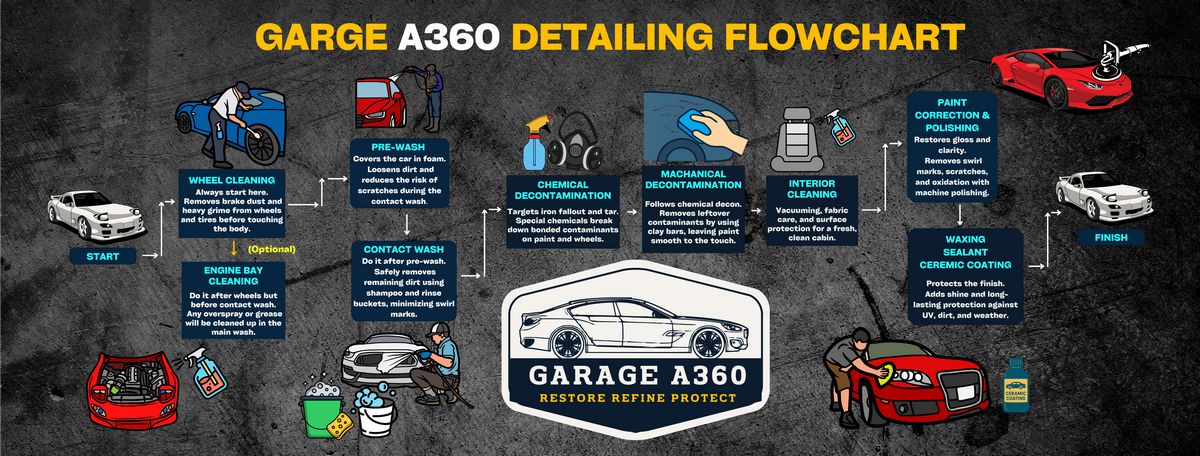
Could you kindly help me with the detailing process flow? I’ve attached my draft flowchart for your reference.

I am still a novice in this field. I completed my CD Chemicals exam last May, and my partner and I are planning to open a detailing garage here in Sri Lanka.

I’m a bit confused about the correct sequence, especially for interior cleaning and glass cleaning.

My current draft looks like this:
  • Engine bay cleaning (optional)
  • Wheel cleaning
  • Pre-wash
  • Contact wash
  • Chemical decon
  • Mechanical decon
  • Interior cleaning
  • Paint correction
  • Paint protection


My questions are:
  1. Is this the correct order?
  2. Where does glass restoration/cleaning fit in?
  3. Can we start with the interior first?
  4. Should I add anything else to make the flowchart more accurate?


I’d greatly appreciate your guidance to ensure I get the proper workflow.
Thank you very much for your time and support.


Best regards,
Anuruddha


Here's the flow chart they are tweaking and finalizing.

full


Mike
 
Below is my stab at helping out... :)


Could you kindly help me with the detailing process flow? I’ve attached my draft flowchart for your reference. I am still a novice in this field. I completed my CD Chemicals exam last May, and my partner and I are planning to open a detailing garage here in Sri Lanka.

I’m a bit confused about the correct sequence, especially for interior cleaning and glass cleaning.

My current draft looks like this:

  • Engine bay cleaning (optional)
  • Wheel cleaning
  • Pre-wash
  • Contact wash
  • Chemical decon
  • Mechanical decon
  • Interior cleaning
  • Paint correction
  • Paint protection

The above looks good to me with these comments,

I see that the engine bay cleaning is optional as it should be. The flow chart shows STARTING with wheels and tires, followed by the optional engine compartment. If it were me, the first item in the flow chart would be the optional engine cleaning because I would clean the engine compartment before I cleaned wheels and tires.

The reason why is because in some cases you tackle the hardest parts first, and in some cases you tackle the things that will get other areas of the car dirty as you do the process. Engine and engine bay cleaning and detailing falls into these two exceptions. That is, if you're going to clean the engine compartment doing what's called a Wet Wash Engine Detail, this is where you use degreasers, brushes and a pressure washer or water spray, then you do this first, before wheels and tires and everything else.

Headlight Correction
I practice and teach doing headlight correction as a part of the Prep Wash process.

Why?

Because one trick when sanding and buffing headlights is to open the hood to get any hood PAINT away from the sanding and buffing process. Factory clearcoats are thin. You want to tape-off any paint or trim next to the headlight with at least 2 layers of protective tape. Then, if you ACCIDENTLY sand any surface next to the headlight, you will prevent a major problem.

I teach using a rotary polisher to machine sand headlights. If the headlights are in really bad condition, I normally start at 500 Mirka Abralon 3" discs on a 3" rotary backing plate with 2-3 foam interfaces pads. With 500 grit, if you accidently run the spinning sanding disc on to factory car paint, in order to work your way out of 500 grit sanding marks to say something like 2000 grit and then start buffing - chances are very good you're going to go through the clearcoat or leave it so thin you risk clearcoat failure.

So, it MUCH safer to tape-off and protect any paint near the headlight.

The Hood is Different
With the hood, you could tape it off, but you can also pop the hood open and COMPLETELY remove this paint from the sanding and buffing process.

Working Smarter instead of Harder
I teach doing headlight correction as a part of what I teach called EXTREME Prep Wash - that is, we do anything that will make the car dirty/messing BEFORE actually washing the car. It only makes sense.

In the context of engine bay detailing, IF you're going to do the headlight correction as a part of the wet work, (washing a car is wet work), then it's SMARTER to do the headlight correction FIRST and then clean the engine bay.

Machine sanding and buffing headlights will sling splatter onto the engine compartment. If you clean the engine compartment first and then do the headlight correction, you risk repeating steps or in other words, wasting time because now you'll have to clean the engine compartment again.


So my order would be, and remember, some of these are OPTIONAL because some cars won't need or get engine detailing and headlight correction, so here's my normal order of process.

1: Topical Glass Polishing - Tape off sensitive gaskets first, while car is dry.

2: Headlight Correction - Sanding and buffing - but not sealing or protecting - save this for later.

3: Engine Detailing

4: Wheels & Tires
Any exterior plastic cladding like running boards, bumper covers (trucks have these), etc. I teach machine scrubbing tires and while you already have a cordless rotary polisher in your hand with a 5" brush, might as well scrub all the plastic cladding at the same time.

5: Pre-Wash - This can be power rinsing, and/or foaming the vehicle and then rinsing before contact wash.

6: Contact Wash and THOROUGH rinse. This usually includes a careful washing of door jambs in a way as to not introduce lots of water into the vehicle.

7: Chemical Decontamination - If I'm going to do any machine polishing, I skip this due to a really bad experience with a NAME BRAND Iron and Fallout Remover staining anodized aluminum trim on a VW Passat. Ever since then, I simply stopped using iron removers on anyone's car.

8: Mechanical Decontamination - I like removing any bonded contaminants while the car is already wet. This saves time, towels and clay lube, plus the car is already wet, if you clay the paint later, you have to get it wet again with clay lube - this is repeating steps and wasting time. There is an EXCEPTION to this rule, and I'll share later in this thread.

9: Final Rinse

10: Dry vehicle
- Blow dry emblems, door handles, any tight areas where water can pool. If the car has not been regularly maintained, this usually means water will NOT easily blow off large body panels, so after blowing out intricate areas, like the grill, etc. then give the vehicle a good hand dry.


Then move the car inside, I have multiple fans I aim at the car to further dry it. While the door jambs are still wet, give them a final wipe with a spray detailer, spray wax, or I use our spray-on ceramic coating - Bead Hero. Might have to wipe these areas a second time after buffing out the car, but at least they will be clean, dry and already slippery so they will re-wipe fast.

Test Spot
Before anything else, do a Test Spot and dial-in and prove your process will work for the paint on this car. Once you prove your process on a body panel like the hood or trunk lid, then it's time to tape-off and cover over.

Tape-off any exterior pebble textured trim - I don't do this until AFTER the Test Spot. I've come across a few cars in my life that simply cannot be saved as proved via the Test Spot. If you pro-actively tape-off any plastic trim or other sensitive surfaces, like matte graphics, etc., and then find out you cannot fix the paint via the Test Spot, then taping off will have been a waste of time and tape.


I think I answered the questions with the above?

My questions are:
  1. Is this the correct order?
  2. Where does glass restoration/cleaning fit in?
  3. Can we start with the interior first?
  4. Should I add anything else to make the flowchart more accurate?


As far as glass polishing goes, there are two types,

Topical Glass Polishing - This is removing any water spots or traffic film off outside glass. I try to do this BEFORE washing as it's very messy and all the splatter that is slung all around the window will wash off when I wash the car.

Sub-Surface Glass Polishing - This is removing actual scratches, like wiper scratches out of the glass. If I'm doing this - it is its OWN job. Not included with any other detailing job and for this reason I would tape-off and cover the entire car with plastic, then polish the glass, then move the plastic cover and then wash the car. At this point, this job is completed. If the owner also wants the interior or exterior cleaned and detailed - this starts a NEW job, new charge.

Interior - Order
The order in which you clean the interior is a lot of personal preference, but I would do it after the Prep Wash and before doing any exterior detailing. This is persona preference as I don't much like cleaning interiors and I always practice doing the hardest things first, to get them over with, or I do them first because I don't like to do this type of work and even though it may not be the hardest part, it's the part I least enjoy, so I get it over with.

How the above?

Mike

 
  • Like
Reactions: Mak
Hi Mr. Mike, Thank you very much for the detailed information.. I have two clarifications..

7: Chemical Decontamination - If I'm going to do any machine polishing, I skip this due to a really bad experience with a NAME BRAND Iron and Fallout Remover staining anodized aluminum trim on a VW Passat. Ever since then, I simply stopped using iron removers on anyone's car.

Question: Only clay bar treatment enough before machine polishing? But what If we cautious about chemical decon interms of the dwell time and making sure to rinse off before the Machanical decon since it's a part of the detailing process.. Also what if the vehicle is having tough iron particles where you can't remove only by a clay bar?


Interior - Order
The order in which you clean the interior is a lot of personal preference, but I would do it after the Prep Wash and before doing any exterior detailing. This is persona preference as I don't much like cleaning interiors and I always practice doing the hardest things first, to get them over with, or I do them first because I don't like to do this type of work and even though it may not be the hardest part, it's the part I least enjoy, so I get it over with.

Question: After prep-wash means after chemical and machanical decon? or after the contact wash?

Look forward to receive your thoughts..
 
Hi Mr. Mike, Thank you very much for the detailed information.. I have two clarifications..


Mike Phillips said:
7: Chemical Decontamination - If I'm going to do any machine polishing, I skip this due to a really bad experience with a NAME BRAND Iron and Fallout Remover staining anodized aluminum trim on a VW Passat. Ever since then, I simply stopped using iron removers on anyone's car.


Question: Only clay bar treatment enough before machine polishing? But what If we cautious about chemical decon in terms of the dwell time and making sure to rinse off before the mechanical decon since it's a part of the detailing process. Also, what if the vehicle is having tough iron particles where you can't remove only by a clay bar?

Great question and or dilemma. If you are dealing with horrible iron contamination, then "yes" look into a quality chemical iron remover. Then here's my strong advice, never get any of this on any type of coated, uncoated or anodized aluminum trim found on a lot of cars. What I went through to remove the spotting on the trim on the Passat was a nightmare.

A good rule of thumb is to keep the spray focused on painted body panels. Perhaps instead of spraying the product on, spray our pour the product into a clean, soft small towel or sponge and hand apply.

My experience may be the exception to the rule, but after going through the experience of staining the trim on some other person's car, I simply don't want to put myself in that position again, thus I rely on the paint correction step to remove ALL contamination.

My brain thinks like this,

If compounding or polishing is REMOVING PAINT - then it is removing whatever contamination is in the top level or top surface of the paint and that's about as good as I care to get.


Mike Phillips said:
Interior - Order
The order in which you clean the interior is a lot of personal preference, but I would do it after the Prep Wash and before doing any exterior detailing. This is persona preference as I don't much like cleaning interiors and I always practice doing the hardest things first, to get them over with, or I do them first because I don't like to do this type of work and even though it may not be the hardest part, it's the part I least enjoy, so I get it over with.


Question: After prep-wash means after chemical and mechanical decon? or after the contact wash?

For me, the Prep Wash - is the contact wash - you're PREPARING the car for detailing, whatever that might include.

I call my Prep Wash and EXTREME Prep Wash because it's MORE than just washing the car. It's a collection of ALL the things I can do to get the car super clean while washing the car. Or another way of saying it is,

Doing all the steps or processes that need to be done while the car is WET.

And I do all the things I can do as a part of the detail - that get the car messy, BEFORE I wash the car so I don't have to repeat steps. For me, it's all about being as time-efficient as possible because it takes a long time to go from start to finish - I try not to make it take any longer.

Mike
 
  • Like
Reactions: Mak
Hi Sir,

This is classic..

Mike Phillips said:
A good rule of thumb is to keep the spray focused on painted body panels. Perhaps instead of spraying the product on, spray our pour the product into a clean, soft small towel or sponge and hand apply.

If compounding or polishing is REMOVING PAINT - then it is removing whatever contamination is in the top level or top surface of the paint and that's about as good as I care to get.

So the correct order would be,

Topical Glass Polishing (Upon Request)
Engine Bay (Upon Request)
Wheel & Rims
Pre - Wash
Contact Wash
Interior Cleaning
Chemical Decon
Machanical Decon
Paint Correction
Paint Protection


You have mentioned, lot of information in detail.. I will throughly follow it up..
 
So the correct order would be,

Topical Glass Polishing (Upon Request)
Engine Bay (Upon Request)
Wheel & Rims
Pre - Wash
Contact Wash
Interior Cleaning
Chemical Decon
Machanical Decon
Paint Correction
Paint Protection

You're close. I think there still may be some confusion about the wash process. Using your steps above, here would be the correct order.

  1. Headlight Correction (Upon Request)
  2. Topical Glass Polishing (Upon Request)
  3. Engine Bay (Upon Request)
  4. Wheel & Rims
  5. Pre - Wash
  6. Contact Wash & Rinse
  7. Chemical Decon & Rinse
  8. Machanical Decon & Rinse and Dry
  9. Interior Cleaning
  10. Paint Correction
  11. Paint Protection
  12. Wipe down all jambs
  13. Dress Tires
  14. Clean all outside glass - (Apply Glass Coating Upon Request)
  15. Final inspection


You have mentioned, lot of information in detail.. I will throughly follow it up..

I hope the above makes sense.

Mike
 
Also just to note,

As an option, you can do the chemical decontamination process BEFORE washing the car. This assumes you're going to spray-on an iron remover or fallout remover. The reason why is you don't want to WIPE on a decontamination liquid if there is still dirt on the car - because you haven't pre-rinsed, or contact washed.

Why?

I use to use this approach because of physics. If you wash and rinse the car and then spray on an iron remover, the action of spraying on an iron remover will BREAK the surface tension between any standing water on the car and the paint and what happens is your chemical decontamination product will simply run off the car and onto the ground. Kind of a waste of product, money and time.

What works better is to spray a DRY car down with your choice of iron remover or fallout remover, allow it to dwell and GO TO WORK ON THE PAINT but without drying, and then blast off with a strong spray of water and/or a pressure washer.

Because you're spraying this liquid chemical cleaner onto a DRY but dirty car, the dryness plus the accumulated dirt/dust/pollen, etc., will hold the liquid chemical decontamination product ONTO the paint, where it can go to work, instead of running off the car.


EXPERTS on the INTERNET
Just to note, there are always experts on the Internet that will say it is their opinion, spraying an iron remover onto dry paint is bad technique. They are entitled to their opinion, but before I stopped using iron removers on car, I did this often without any problems.

So just be aware, spraying a liquid chemical decontamination product onto dry paint can come with risks. You should always read the directions on the label of the product and heed the instructions of the manufacturer because they know their products chemistry best.


Mike
 
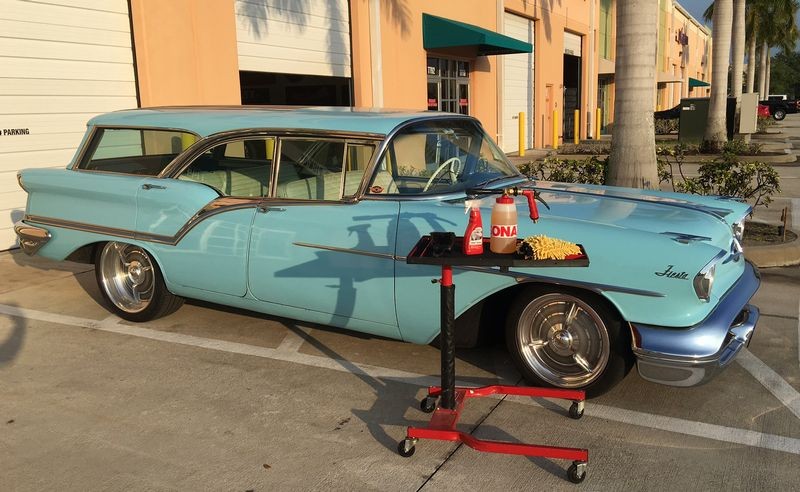
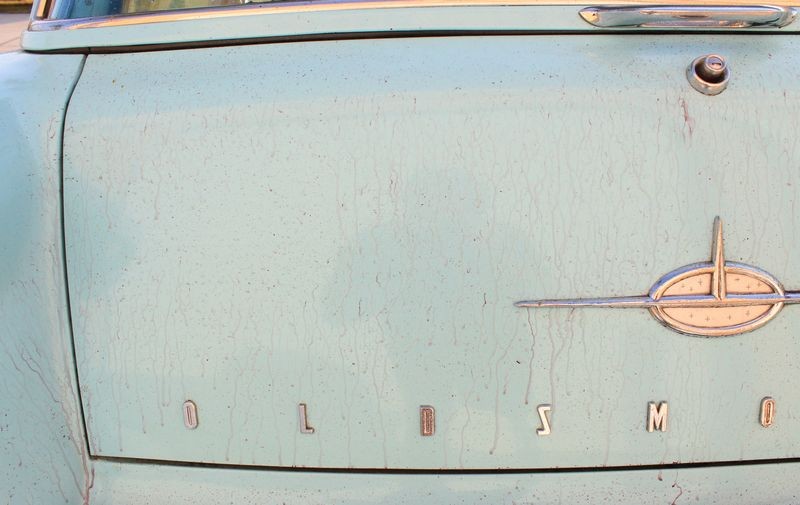
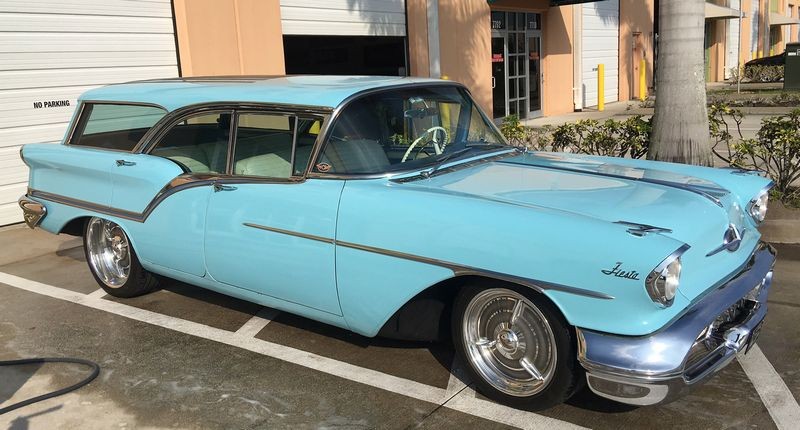
Here's a car I used a popular fallout remover on where the paint was DRY and then I followed with rinsing and then washing the car.

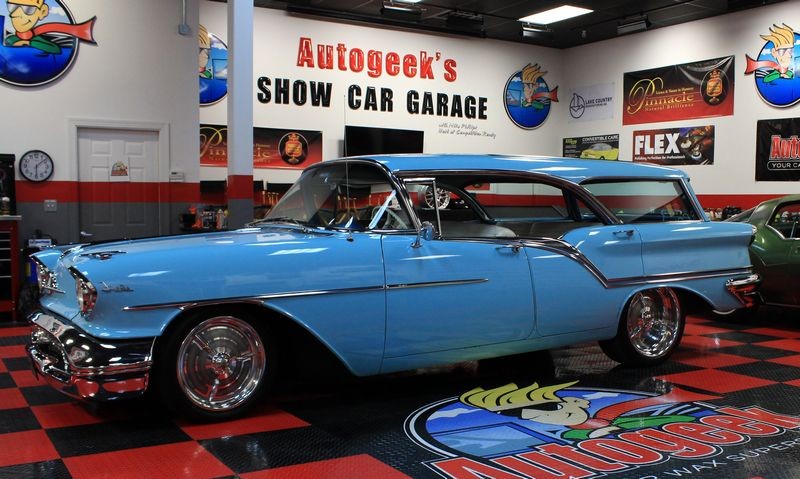
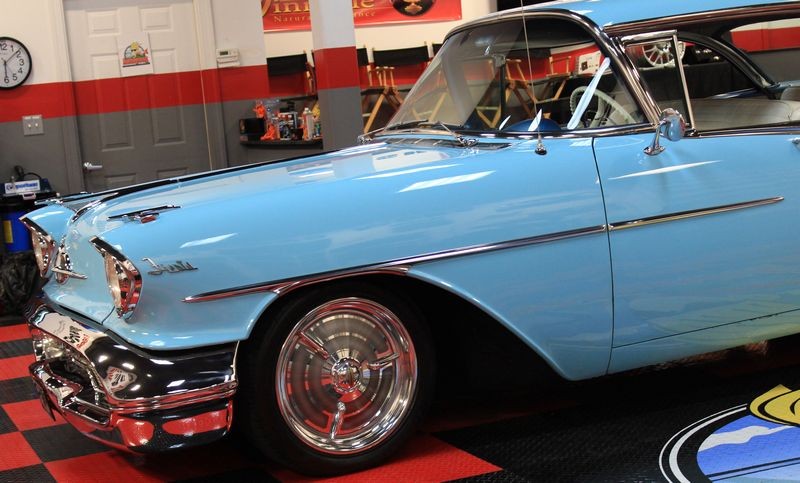
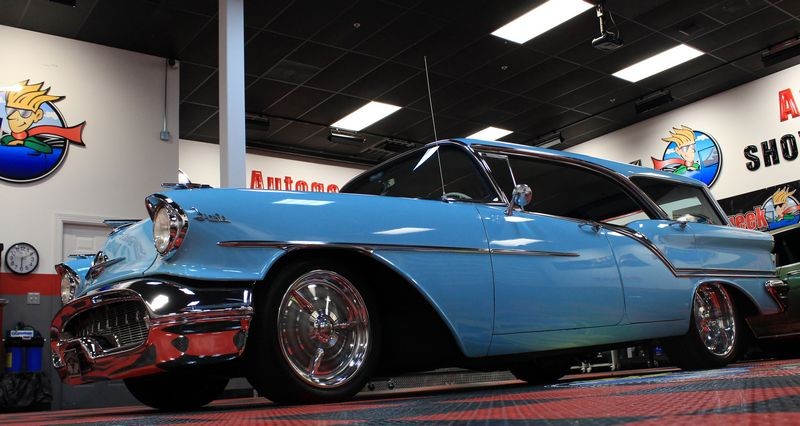
My very good friend Mike Stowe, former owner of Classic Instruments and bonafide car guy in the car hobby purchased this 1957 Oldsmobile from a museum. He installed a big block 455 Olds engine with aluminum heads and a big cam to help it get the groceries home. He also had some one-off custom wheels made for it and stuck some fatties in the back to help it launch off the line a little better... don't want the ice cream to melt before you get the groceries home.

Outside of that and a couple of wash jobs he says he's never done anything else to it. So I asked him if I could warm it over and amp up the gloss and clarity to the antique single stage paint and he said

She's all yours...


I also asked if it was okay to wash the car and Mike said yes . I don't normally wash classics like this but since he said he's already washed it a few time there's nothing I'm going to do that he hasn't already done in the way of getting water into all the nooks and crannies. So first process for this project...

Wash and chemically decontaminate the paint

In case you've never buffed out original, single stage lacquer or enamel paints, you can get AMAZING GLOSS out of them as they react so well to machine polishing. But first I need to create a foundation for which to build off of and that means chemically decontaminating the paint, getting the car uber clean and then I'll follow up with claying, machine polishing and then waxing.


So here's my preferred way to chemically decontaminate paint.

Step 1: Before getting the car wet, spray each panel down with a quality product that will remove all the junk that can build up on car paint over time. The SONAX Fallout Remover is more than an iron remover as it also removes industrial fallout, pollution and lime deposits.


Note the warm, gold glow this pictures has? The sun is just coming up over the horizon, it's early in the morning and temperatures are still cool.

SONAX_Fallout_001.JPG


I've detailed 3 cars in the last year that were all purchased out of Museums and all of them needed decontamination, correction and polishing work and of course... a fresh coat of wax.

SONAX_Fallout_004.JPG


SONAX_Fallout_005.JPG


SONAX_Fallout_006.JPG


SONAX_Fallout_007.JPG


SONAX_Fallout_008.JPG


SONAX_Fallout_009.JPG


SONAX_Fallout_010.JPG


SONAX_Fallout_011.JPG


SONAX_Fallout_012.JPG


SONAX_Fallout_013.JPG


SONAX_Fallout_014.JPG


SONAX_Fallout_015.JPG


SONAX_Fallout_016.JPG


SONAX_Fallout_017.JPG


SONAX_Fallout_018.JPG


SONAX_Fallout_019.JPG


SONAX_Fallout_020.JPG


Then I rinsed off all the iron being chemically dissovled.

SONAX_Fallout_027.JPG


and then dried the car

SONAX_Fallout_021.JPG


And then of course, I did a full detail job, inside and outside and this was back in 2017, while I was still at the geek.


Jay_Leno_Metal_023a.jpg


Jay_Leno_Metal_024.JPG


Jay_Leno_Metal_025.JPG


Jay_Leno_Metal_026.JPG


Mike
 
And for what it's worth, the product I used with zero problems on this classic car is the product that stained the trim on the Volkswagen Passat.

I shared pictures of the damage with the company but never heard anything back. After that, I stopped using this product and all iron removers. Instead, I know that when I do the paint correction step, because I'm removing paint, I trust that I'm also removing any topical contamination but without putting myself or the vehicle or vehicle trim at risk.


Mike
 
You're close. I think there still may be some confusion about the wash process. Using your steps above, here would be the correct order.

  1. Headlight Correction (Upon Request)
  2. Topical Glass Polishing (Upon Request)
  3. Engine Bay (Upon Request)
  4. Wheel & Rims
  5. Pre - Wash
  6. Contact Wash & Rinse
  7. Chemical Decon & Rinse
  8. Machanical Decon & Rinse and Dry
  9. Interior Cleaning
  10. Paint Correction
  11. Paint Protection
  12. Wipe down all jambs
  13. Dress Tires
  14. Clean all outside glass - (Apply Glass Coating Upon Request)
  15. Final inspection


I hope the above makes sense.

Mike

This is absolutely awesome Sir.. Let me share my new corrected detailing flowchart with you..
 
Back
Top